


Several Supreme Court justices appeared skeptical Wednesday of the Trump administration’s effort to end automatic U.S. citizenship for children born to undocumented migrants.
Solicitor General D. John Sauer argued for the federal government, while Cecillia Wang, national legal director of the American Civil Liberties Union, argued on behalf of challengers.
At issue is the interpretation of the first section of the 14th Amendment, which states: “All persons born or naturalized in the United States, and subject to the jurisdiction thereof, are citizens of the United States.”
Sauer argued that children born to undocumented migrants are not automatically entitled to citizenship, focusing on the amendment’s phrase “subject to the jurisdiction thereof.” He also emphasized the concept of “domicile,” arguing that if parents are not legally established in the United States, their children should not automatically receive citizenship.
But several justices, including both liberals and some conservatives, questioned that interpretation. They pressed Sauer on whether anyone physically present in the U.S. is inherently subject to its laws, and how the government would determine citizenship at birth.
“Is this happening in the delivery room?” Justice Ketanji Brown Jackson asked, highlighting concerns about the practical implications of enforcing such a policy.
Justice Amy Coney Barrett also challenged the administration’s argument.
“You say that the purpose of the 14th Amendment was to put newly freed slaves on equal footing so they would be citizens. But that’s not textual,” Barrett told Sauer, as he pointed to historical context from the 19th century.
At times, it appeared Sauer was being heavily questioned by the court, with multiple justices returning to the meaning of “jurisdiction” and whether longstanding precedent supports birthright citizenship regardless of a parent’s immigration status.
President Donald Trump attended part of the arguments, becoming the first sitting president to do so.
Trump sat in the first row of the public section alongside Attorney General Pam Bondi and other administration officials, rather than in the section typically reserved for counsel. He entered shortly before the justices took the bench and, like others in the courtroom, stood as they entered.
He left shortly after Sauer concluded his argument.
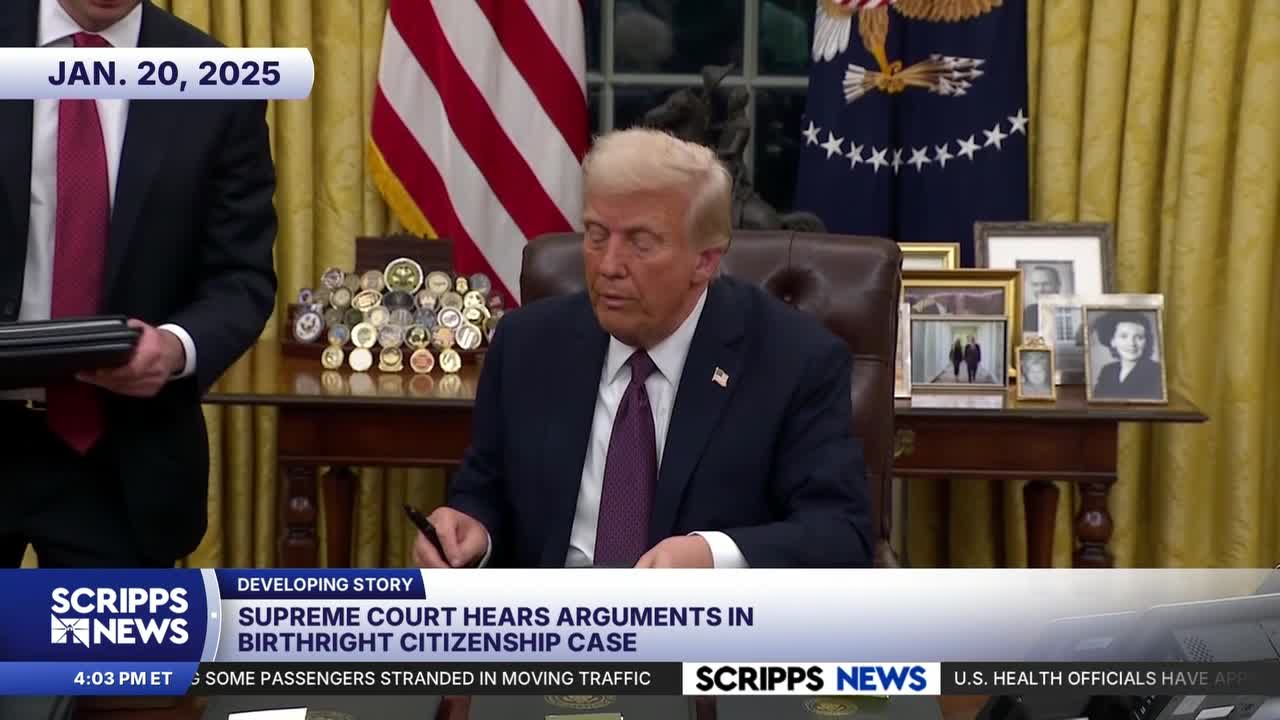
Trump signed the executive order at the center of the case on the first day of his second term as part of what the White House described as an effort to “repair the United States immigration system.”
The ACLU, which is challenging the order, says birthright citizenship has been applied for more than a century regardless of a child’s parents’ immigration status.
“I’m confident that the court is going to turn back this president’s effort to radically rewrite our 14th Amendment rule,” Wang said outside the court after arguments. “We have a nation of millions on our side. We couldn’t be more confident about arguments here.”
The group warns that a ruling in favor of the administration could create widespread complications.
According to the Migration Policy Institute, more than 250,000 children could be denied U.S. citizenship each year if the court sides with the Trump administration.
